

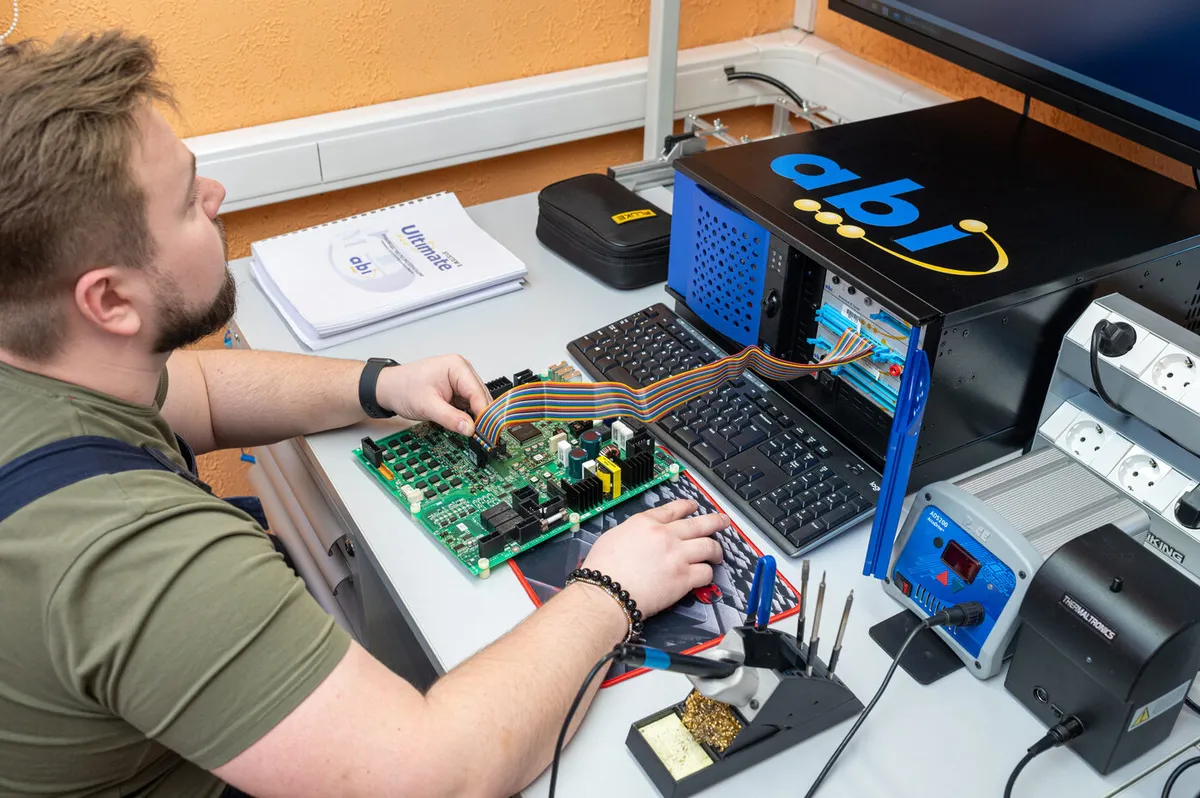
Compressor VSD board repair almost always starts with the same event: a grid surge. Impulse overloads and voltage sags destroy the input circuits and power switches of the variable frequency drive, and the compressor stops along with them. Let us break down exactly what grid surges damage, why replacing the whole unit is overkill, and how we restore VSD boards without shutting down the entire station.
The role of a VSD on a compressor station
A variable speed drive (VSD, also known as a variable frequency drive) controls the compressor motor speed, ramping it up and down smoothly instead of a hard start straight from the grid. This reduces mechanical stress, saves energy, and holds line pressure precisely.
Inside the drive are two key layers of electronics: a control board with a controller and gate drivers, and a power stage with a rectifier, a DC link, and an inverter built on IGBT modules. A failure in either layer stops the compressor, and in gas transport that means an entire node dropping out of the process chain.
What is specific about compressor stations is that the drives run almost continuously and under high load. The thermal regime of the power stage is always demanding, and any external grid disturbance lands on components that are already hot. So VSD boards age faster than in equipment with infrequent starts, and a grid surge is often just the last straw for a node that has already degraded.
What grid surges damage
Power on industrial sites is far from ideal: switching transients, lightning-induced spikes, sags, and phase imbalance. The input circuits take the first hit:
- Input filters and chokes that suppress noise and inrush current.
- Varistors and snubbers that clamp overvoltage: they degrade and go to short circuit.
- IGBT power switches in the inverter, whose breakdown often takes the gate drivers with them.
- DC link capacitors that lose capacitance and bulge after overloads.
Damage rarely stops at a single component: a shorted switch loads the driver, and the driver in turn loads the control board’s supply circuits.
Typical board damage
On the control board we most often see burned drivers, damaged current and voltage sensing circuits, and degraded regulators. On the power stage: shorted IGBT modules, bulging electrolytic capacitors, and scorched high-current traces and connectors.
Each of these has a characteristic signature, and experienced diagnostics tells a primary failure apart from secondary consequences. This is crucial: if you replace only the shorted switch without finding the root cause, the drive will fail again on the next start.
Cascading failures are a difficulty of their own. The breakdown of a single IGBT module often creates an overcurrent that burns the gate driver, which in turn drags down the supply and protection circuits of the control board. By the time the drive stops, several components are already damaged, and the whole chain needs restoring, not just the obviously burned part. A missed secondary defect is the single most common reason a board that came back from repair fails again.
Why replacing the whole unit is overkill
A full VSD unit swap is the most expensive and not always available option: on aging equipment the original units are often out of production. Meanwhile the actual failure is usually localized to a few components, while the rest of the board is fine.
We favor component-level repair over module swap: it is cheaper, faster, and preserves compatibility with equipment already installed at the station. We apply the same approach across all of our oil and gas electronics repair.
Diagnostics: localization down to the component
Repair starts with precise fault localization. Thermography reveals overheated nodes under load, and analog signature analysis on ABI BoardMaster instruments identifies shorted junctions and degraded components without powering the board. The method is covered in detail in our article on fault localization with BoardMaster.
This approach separates the primary failure from the secondary ones and prevents scrapping a board that is still good. All work runs under ESD control so static does not damage sensitive components.
The repair workflow
The workflow is transparent and protects the customer’s budget:
- Fault localization down to the specific component.
- Cost and scope approval before any soldering begins.
- Replacement of damaged components, trace restoration per IPC-7711/7721.
- Quality acceptance per IPC-A-610 and restoration of the conformal coating.
We do not start soldering until the customer has approved the cost: this rules out the situation where a repair turns out more expensive than expected.
If diagnostics show the repair is not economically sound, for example when a large part of the power assembly is damaged, we say so honestly before any work begins. Transparency at this stage spares the customer the expense of restoring a board that is ultimately cheaper to replace.
Bench run and burn-in
The reassembled board goes through a bench run under a load that mimics the drive’s real operating conditions. The run weeds out early failures of the restored nodes before the board returns to the station: we described the logic of burn-in testing in our piece on the post-repair run.
Only after passing the bench run is the board declared ready to install. That is how we avoid a repeat callout and an unplanned compressor stop.
How to reduce the risk of repeat failures
Repair returns the board to service but does not undo the cause that took it out. If the grid on site regularly produces spikes and sags, it makes sense to review the drive’s input protection: the condition of the varistors and snubbers, the presence and health of line chokes, and the quality of grounding.
We note in the report whether the failure was a one-off event or the consequence of a systematic power problem. This helps the maintenance team decide whether the repair is enough or the input circuits should be reinforced. A scheduled review of VSD boards, checking DC link capacitors, switches, and drivers, catches degradation before an emergency stop and costs a fraction of an urgent repair.
Bottom line
Grid surges are a predictable cause of VSD board failures, and the failures themselves are almost always localized and repairable. Component-level restoration costs a fraction of a unit swap, preserves compatibility, and returns the drive to service without shutting down the whole station.
Submit a request if you need a specific VSD board repaired: we will localize the fault down to the component, approve the cost before soldering, and return the board verified under load on the bench.