

Marine navigation electronics operate in one of the harshest environments found anywhere in engineering. Salt air, condensation, constant vibration, and temperature swings quickly destroy contacts and board finishes. Even a local failure can disable the entire navigation chain, and aboard a vessel that means not just a breakdown but a risk to safe passage and forced downtime while a spare is on its way.
Restoring marine navigation electronics is component-level work, where it matters not only to replace the damaged element but to return the board’s resistance to the very environment that destroyed it. Below we cover what actually fails, how diagnostics are done, and why repair often beats replacing the whole unit.
What destroys electronics aboard a vessel
The marine environment attacks electronics from several directions at once, and each factor reinforces the others.
The main enemy is corrosion. Salt fog penetrates instrument housings, settles on boards, and starts electrochemical processes that eat away traces, pads, and component leads. Where residual voltage is present, corrosion runs even faster, forming conductive bridges and leakage paths.
The second factor is vibration. Constant shaking from the main engine and sea state loosens solder joints, breaks leads, and causes fatigue cracks in contacts and connectors. The third is humidity and condensation, which seep under poor or damaged coatings. Together these threaten navigation systems: ECDIS (electronic chart display systems), radar, gyrocompasses, and echo sounders, where the failure of a single board can bring down the whole chain.
Diagnosing the navigation unit
Restoration starts with full diagnostics, not with a guess-and-swap replacement of the board. The goal is to understand the depth of the damage and find every affected circuit, not just the obvious ones.
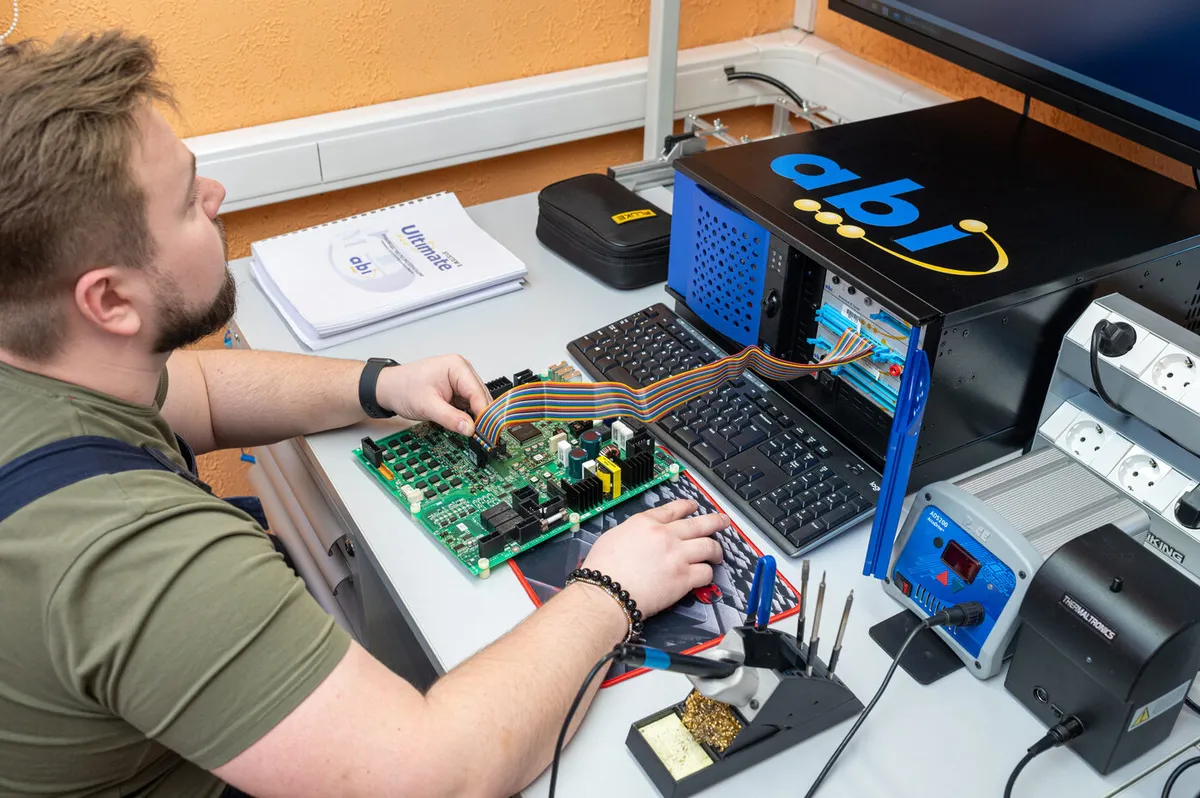
We inspect the board under magnification to assess the extent of corrosion, then localize electrical faults instrumentally. An oscilloscope and multimeter show where the signal is lost or distorted, while comparative diagnostic methods help find degraded components that still formally work but are already on the edge of failure. A separate difficulty is the obsolete component base: navigation equipment serves for a long time, and some parts reached EOL or obsolete status long ago, so a verified equivalent that preserves the ratings is selected for replacement.
How restoration is carried out
Once diagnostics are complete, the repair itself begins, and here it is important to eliminate not only the symptom but the conditions for a repeat failure.
As a result of the work, we restore traces and connectors affected by corrosion, replace damaged DC-DC converters and other failed components, and clean the board of corrosion products that would otherwise keep destroying it from within. Soldering is done under electrostatic discharge protection (ESD) and to industry standards: assembly criteria come from IPC-A-610, while the repair and rework procedures come from IPC-7711 and IPC-7721. This guarantees that the restored area is no weaker than factory assembly.
The final and perhaps most important stage for marine electronics is moisture protection. Conformal coating re-insulates the board from salt fog and condensation, restoring its resistance to the marine environment. The board then goes through a burn-in test under load to confirm stable operation before it returns to the vessel.
Which instruments we restore most often
A vessel’s navigation chain consists of several interconnected systems, and corrosion or vibration can take any of them out of service. Each type of instrument has its own characteristic failures.
In ECDIS and chart systems, power boards and interface modules suffer most often: display backlight goes out, data exchange with sensors glitches, and the link to the satellite navigation receiver is lost. In radar, the modulator and receiver paths are vulnerable, along with the antenna rotation circuits, where vibration and moisture quickly destroy connectors and power switches.
Gyrocompasses and heading systems are sensitive to degradation of the power supply and amplifier stages: even a small drift in parameters affects heading accuracy. Echo sounders and logs suffer from corrosion in their weak-signal receiving paths. In every case, component-level restoration preserves the original instrument, which is already matched to the rest of the vessel’s navigation equipment, instead of hunting for a scarce replacement.
Why repair beats replacement
For a shipowner, the difference between repair and replacing the unit is measured first of all in downtime.
Replacing a board means waiting for delivery, and for navigation equipment the original is often discontinued and takes weeks to arrive. During all that time the vessel either sits idle or sails under restrictions. On-site or fast-turnaround repair returns the unit to service sooner and cheaper, while a restored and re-protected board is no less reliable than a new one. It also extends the life cycle of the equipment and reduces the volume of e-waste, which we cover in more detail in our article on why a discarded board isn’t always trash.
How to extend service life after repair
Restoring a board eliminates the consequences, but the marine environment will not go away, so it is important to reduce the chance of a repeat failure. A few measures help extend the service life of navigation electronics after repair.
The first is the tightness of housings and seals. It is precisely through damaged gaskets and open cable entries that salt fog gets inside an instrument, so checking and restoring seals is as important as the board repair itself. The second is quality conformal coating, which we reapply across the whole board rather than only the repaired area, so as not to leave exposed zones.
The third is regular inspection. Early traces of corrosion on contacts and connectors are visible long before a failure, and dealing with them costs many times less than restoring a burned-out path. We note such observations in the report so that the crew and the technical service know which nodes to watch first.
Documentation for the classification society
Marine electronics are a supervised area, so the repair must be not only sound but also documented.
We repair marine electronics with full documentation for classification societies: a description of the faults found, a list of the work performed and components replaced, and confirmation of compliance with assembly standards. Such a report simplifies acceptance of the equipment and removes questions during later inspections.
If you have a navigation unit damaged by corrosion or vibration, submit a request and we will assess repairability before you commit to a costly replacement.