

Repairing metro signalling boards is a discipline of its own, where the cost of a mistake is measured not in money but in safety of movement. Signalling and interlocking units govern signals, points, and the interlocking logic that physically prevents two conflicting routes from being cleared at the same time. When such a board fails, the depot faces a choice: wait weeks for a new unit, or restore the existing one in a matter of days.
Signalling boards often suffer from voltage spikes on the onboard and station networks. Input protection, op-amps, and galvanic isolation circuits are typical casualties, and behind them the logic that has to work without fail. Below we explain why this happens and what proper restoration looks like.
Why signalling boards fail
Metro equipment operates in harsh conditions: constant switching noise, vibration from rolling stock, and swings in temperature and humidity inside tunnels. All of this stresses electronics that were designed decades ago.
The main enemy of signalling boards is voltage spikes. A sharp rise in potential on the network breaks down input protection elements: TVS diodes, varistors, and rectifiers. If the protection fails to absorb it, the surge travels on to the op-amps and comparators that form the signalling logic. In the worst case, the galvanic isolation circuits that separate the power side from the control side are damaged.
A separate difficulty is the age of the equipment. Many units are built on a component base that was discontinued long ago. An original part with EOL or obsolete status simply cannot be found in any new product, so repair calls for a verified equivalent that preserves the ratings for voltage, current, and switching speed.
Component-level diagnostics
Restoration starts not with a soldering iron but with diagnostics. The goal is to find the specific faulty element, not to swap the whole board by trial substitution.
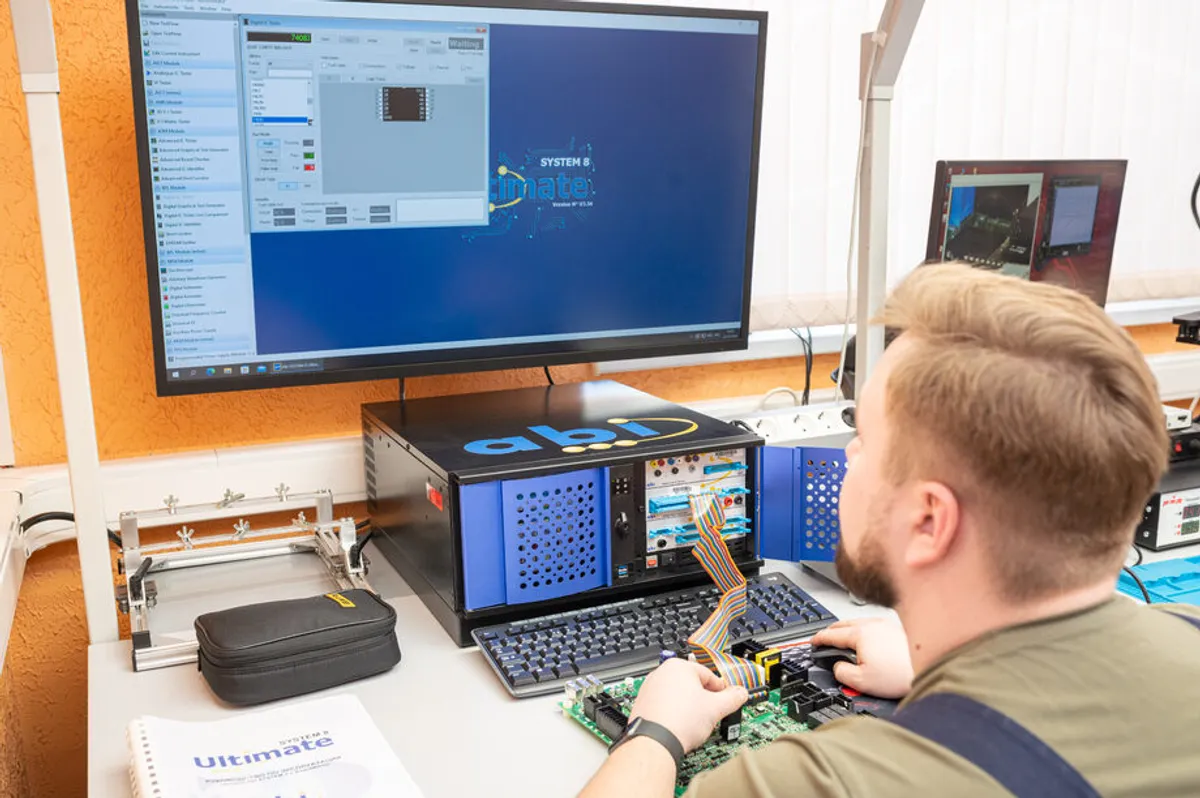
We localize the fault with instrumental methods. An oscilloscope shows the signal waveform at test points, a multimeter and component tester read part parameters, and specialized equipment such as BoardMaster compares circuit behavior against a reference without applying operating voltage. This locates punched-through junctions and degraded elements in seconds where a manual search would take days.
The diagnostics are documented. As a result, the customer receives not just a repaired board but an understanding of exactly what failed and why, which helps eliminate the cause at the system level rather than waiting for a repeat failure.
How restoration is carried out
Once the fault is localized, the repair itself begins. Here it matters not only to replace the component but to return the board to a condition fit for long service in a safety-critical system.
We restore damaged traces and pads, replace failed input protection, op-amps, and isolation elements. Work is carried out under electrostatic discharge protection (ESD), because a static discharge can quietly damage sensitive logic before assembly is even complete.
Quality criteria come from industry standards. Acceptance of solder joints and assembly follows IPC-A-610, while the repair and rework procedures follow IPC-7711 and IPC-7721. This is not a formality: a common standard means the board after repair meets the same requirements as factory assembly.
Verification before returning to service
A signalling board cannot go back into service simply because it powered up on the bench. A signalling system must operate without fail, so final verification is mandatory.
We run a burn-in test under load that simulates the operating mode and reveals intermittent defects that only appear when warm or under current. Where needed, the board is treated with protective conformal coating to withstand moisture and vibration in tunnel conditions. Only then is the unit sent back to the depot with a documented report and a warranty.
Why depot downtime is expensive
The cost of restoring a board is almost always incomparable with the cost of the downtime itself. When a signalling unit fails, an entire section or a piece of rolling stock can drop out of service, and train movement is organized on fallback schemes with restrictions. Each day in that mode is not only a direct loss but also extra strain on adjacent equipment and staff.
The problem is compounded by the fact that a new unit to replace the failed one often cannot be bought quickly. Signalling equipment was designed for specific series of rolling stock and station systems, and its component base was discontinued long ago. Delivery of an original unit, if it is still produced, stretches to weeks, and the compatibility of a new product with the existing logic has to be verified separately.
Component-level repair breaks that dependence. The restored board returns to the same system it was already matched to, without the risk of incompatibility and without a long wait. For the depot this means a predictable schedule and the ability to keep repaired units in an exchange pool, cutting reaction time to future failures.
Repair documentation and traceability
For systems responsible for safety of movement, what matters is not only the result of the repair but its traceability. The depot has to know exactly what was done to the unit, which components were replaced, and against which criteria the work was accepted.
We record the whole cycle: incoming diagnostics results with the faulty circuits identified, a list of replaced components with their ratings, a reference to the assembly standards applied, and the outcome of the burn-in test. Such a report makes it possible to keep a history for each unit and to spot when the same node fails repeatedly, which already points to a systemic cause outside the board itself.
Traceability also simplifies planning of the exchange pool. Knowing the typical failures by equipment series, the depot can keep restored units on hand for replacement and avoid halting a section while it waits for a repair. This turns a one-off repair into a managed life cycle support process.
Outcome for the depot
This approach gives the depot a predictable, fast restoration cycle instead of a long wait for new units.
- Turnaround from 5 business days
- Documented diagnostics that identify the cause of failure
- Restoration of obsolete and discontinued component bases
- Warranty on completed work
Component-level repair extends the life cycle of the equipment and removes dependence on the supply of units that are no longer produced. We explain in a separate article why a discarded board isn’t always trash, and a comparison of board repair versus module replacement shows the difference in numbers.
If you have faulty signalling units or other metro equipment that needs restoring, submit a request and we will assess repairability before any decision to scrap.