

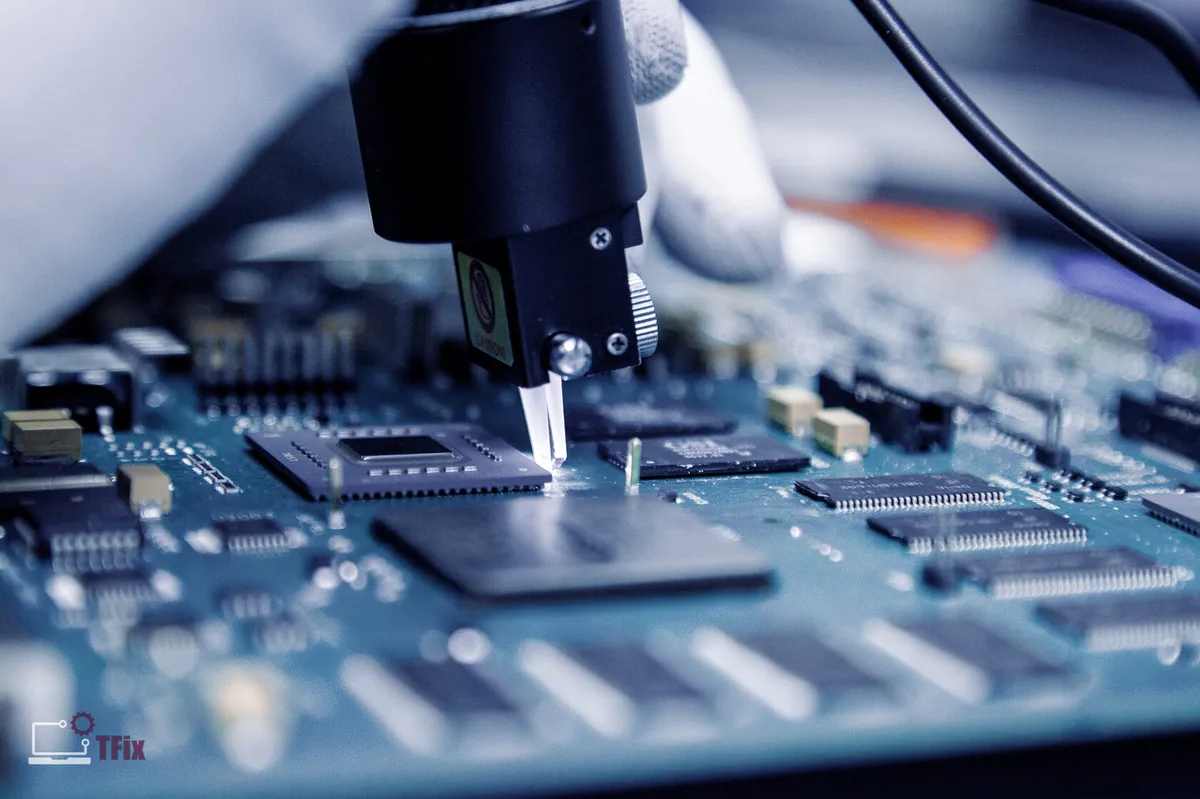
Train door control modules live in one of the least friendly places in a rail car. The controller takes vibration at every rail joint, temperature swings each time the doors open at a stop, and moisture that seeps in through the cable glands. Over time the contacts oxidize and the sensor circuits start producing false triggers.
A door is a safety system. A false opening in motion and a lockout at a stop are equally unacceptable, so we approach these units more strictly than ordinary power electronics. Below we break down why door controllers fail and how we restore the board without replacing the whole module.
Why door controllers fail
There are several causes, and they usually act together. The first is moisture. Condensation enters the housing through unsealed cable glands, settles on the connectors and triggers electrochemical corrosion of the contacts.
The second is vibration. Constant shaking loosens the solder joints of connectors and heavy components, forming microcracks in the solder that first cause an intermittent contact and later a full open circuit.
The third is power-switch wear. The door drive motor starts hundreds of times per shift, and every start is a current surge through the output stage. Switches and gate drivers degrade, heating rises, and switching reliability drops.
The fourth is terminal blocks and cable connections. A loosened screw terminal or a corroded lug produces the same rising contact resistance as a corroded connector, and over time it leads to local overheating and a lost signal at the controller input.
False sensor triggers
A separate headache is the position and obstacle sensors. When a sensor’s contacts oxidize or a microcrack appears in the circuit, the signal becomes unstable. The controller sees the door as open one moment and closed the next, or registers an obstacle where there is none.
To the driver this looks like random faults that are hard to reproduce in the depot. We chase the cause at the circuit level rather than the symptom: we capture waveforms on the signal lines under vibration load and find the exact point where contact is lost.
Why door faults are dangerous
A faulty door directly affects safety and the schedule. A jammed leaf delays boarding and throws off the headway, while a false opening in motion is a direct threat to passengers. That is why door controllers cannot be repaired on a leftover-priority basis.
We treat them as part of a safety system: we check not only the failed node but the interlock logic, so that after the repair the door opens and closes strictly by the regulations. Any deviation in the behavior of the safety circuits is a reason to keep diagnosing, not to close the ticket.
Typical repair flow
The sequence is built to find the root cause, not to swap half the board at random.
- Diagnostics on the ABI BoardMaster: we compare the faulty board against a reference by each net and quickly localize the deviations. More on the method is in our article on fault localization with BoardMaster.
- A thermal scan under power to find hidden overheating from leakage currents. We covered this in our piece on thermal scanning before repair.
- Replacement of damaged connectors and power switches, restoring the landing pads to the IPC-A-610 standard.
- Verification of the safety circuits and interlock logic.
All work is done under ESD control and follows the IPC-7711/7721 rework standard. This matters: a static discharge damages IC inputs invisibly, and the failure only appears out on the line.
Solder inspection and protection against repeat failure
After components are replaced, every joint goes through solder quality control. For hidden leads under BGA packages we use X-ray inspection, and when the balls have degraded we reball the device. The criteria we use to grade restored joints are described in our article on BGA solder joint inspection.
So that the unit does not come back with the same fault, we address not only the effect but the cause. The board is cleaned of flux residue and given a conformal coating that protects the traces from moisture. Where needed, we rework the sensor input stages with current and voltage limiters, so that an open in a sensor does not take the whole controller down with it.
Diagnostics under vibration
The trickiest door-controller faults are the intermittent ones. At rest on the bench the board works fine, but in motion the contact drops out. So we reproduce the working conditions: we apply vibration and capture signals from the suspect circuits at the same time.
This method catches microcracks in connector solder and fatigue defects that a static continuity check can never find. We record the exact moment contact is lost and tie it to a specific joint, rather than swapping components at random.
What the customer gets
At intake we photograph the initial state: moisture traces, oxidized contacts, damaged traces. After diagnostics we agree on the defect list and the scope of work before the repair begins, with no surprises on price.
The finished unit comes back with a description of the work done and operating recommendations. For us, repair is meaningful restoration rather than a consumable: we aim for the controller not to return with the same fault, not just to close the ticket and push the problem to the next run.
Repair instead of module replacement
Swapping the entire door control unit looks like a quick fix, but it is expensive and not always possible: some modules are out of production. Component-level repair restores the board to its original parameters for less money and less downtime. We compared the two approaches in detail in our article on component repair versus module swap.
Before release, the board runs through burn-in testing under a load that imitates real door open and close cycles. This weeds out hidden defects before the car goes back into service.
When the doors keep letting you down
Recurring door faults are almost always connector corrosion, solder fatigue or unstable sensors. We repair these units as part of our rail electronics repair service and apply the same approach to metro equipment, where the doors work at an even tighter pace and the open-close cycle repeats more often.
The sooner connector corrosion is caught, the cheaper the repair: a neglected defect has time to damage neighboring circuits and traces. Regular diagnostics of door units within the maintenance cycle cut the number of sudden failures on the line.
If door controllers in your fleet keep failing, request a diagnostics quote. We will pin down the exact cause, show a transparent report before any work begins, and return the unit protected against a repeat failure.