

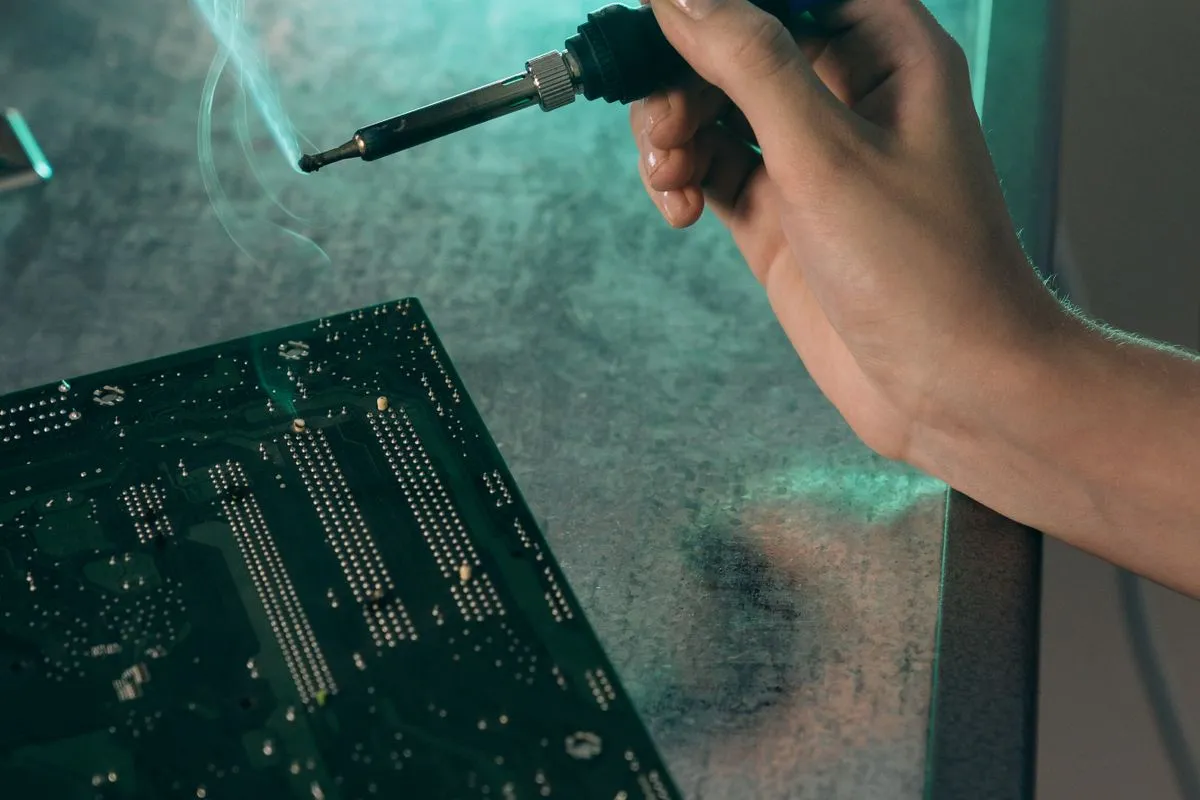
A BGA rework station is specialised equipment for working with chips in ball-grid packages, and reballing such chips is one of the most delicate kinds of industrial electronics repair. In a BGA package the leads are hidden under the base as an array of solder balls, and you cannot reach them with an iron or a probe. Below we go through in detail what we can do on a BGA station: removal, pad cleaning, reballing through a stencil, profile tuning and quality control.
How a BGA station works
A BGA station combines top and bottom heating with precise temperature control. The top heater (hot air or infrared) heats the chip body, the bottom preheater raises the temperature of the whole board evenly. This split is fundamental: without bottom preheat it is impossible to bring the ball array up to reflow without burning the die from above.
Infrared heating transfers heat through radiation and works well for even heating of large packages. Hot air heating works with an airflow through a nozzle sized to the package. We choose the method to match the specific chip, board size and thermal mass, rather than working on one universal mode.
Temperature is controlled separately on the station with thermocouples placed on the board next to the package. The real profile is built from their readings, not from the numbers on the panel. For planar packages without balls we use a separate hot air rework station, while the BGA station remains the tool specifically for ball leads.
Removing a BGA chip
Removing a BGA is a high-risk operation, because heating and lifting a heavy package can take the board’s contact pads with it. We follow a strict sequence.
First the board is heated evenly from below to a temperature close to flux activation, to relieve internal stress and rule out thermal shock. Then top heat brings the package up to ball reflow temperature. The chip is lifted with a vacuum pickup strictly vertically and only once the entire ball array has gone into the liquid phase - lifting with partially solidified solder rips the pads off.
Key points of removal:
- Mandatory bottom preheat so as not to drive the top heater to its limit temperature.
- Detecting the reflow moment by thermocouple, not by eye.
- Vertical vacuum lift with no side shift, so as not to touch neighbouring parts.
After the chip is removed, uneven old solder remains on the board pads and on the package itself, and it must be fully removed before reballing.
Cleaning the pads
The quality of reballing depends directly on surface preparation. Residues of old solder, flux and traces of past heating must be removed down to a clean, flat base.
We clean the contact pads with fluxed wick, taking the old solder down to a flat layer with no bumps or bridges. The area is then washed free of flux residue, because contamination under the future package causes leakage currents and corrosion. The pads are inspected under a microscope: if a previous repair or overheating damaged the mask or lifted a pad, this is found at this stage and resolved before the balls go on.
The same cleaning is performed on the chip itself if it is to be reinstalled rather than replaced with a new one. A flat, prepared surface is a mandatory condition for an even array of new balls.
Reballing through a stencil
Reballing is the application of a new array of solder balls onto the chip pads. We do this through a stencil that exactly matches the pitch and ball diameter of the specific package.
The stencil workflow:
- The stencil is aligned to the chip pads so that each opening sits exactly on its contact.
- Calibrated solder balls of the correct diameter are loaded into the openings, or solder paste is applied.
- The array is reflowed on a profile at which the balls form and attach to the pads.
- The stencil is removed and the result is inspected under a microscope for completeness and evenness of the array.
The ball diameter and solder type are chosen for the specific package: lead-free assemblies use the matching alloy with a higher reflow temperature. An error in diameter or pitch leads to ball collapse or bridges at final placement, so we select the stencil and balls strictly by the package documentation.
Tuning the reflow profile
The reflow profile is the decisive factor in reballing. The profile describes how temperature changes over time: preheat, the flux activation zone, the reflow peak and controlled cooling.
We build the profile for the specific solder and package, controlling it with a thermocouple on the board. The main principles:
- A gentle preheat to activate the flux and relieve stress without thermal shock.
- Sufficient but not excessive time above liquidus: overheating destroys the flux, oxidises the solder and damages the die.
- Controlled cooling, because a sharp drop gives brittle joints and warping.
Too high a temperature damages the chip die, too low a temperature leaves unsoldered balls and cold joints. A broken profile is the most common reason someone else’s previous reballing has to be redone: the board looks repaired on the outside, while the X-ray shows voids and deformed balls.
Chip placement and quality control
After reballing the chip is set back onto the board. The package is aligned precisely to its footprint, flux is applied and the array is reflowed on the profile. With a correct profile the surface tension forces pull the package onto the pads - the self-alignment effect typical of BGA.
BGA joint quality cannot be judged by eye alone, because the balls are hidden under the package. We use several methods:
- X-ray inspection as the main tool: it shows the ball shape and evenness, voids, bridges and package offset.
- Microscope inspection around the package perimeter to assess seating and any visible defects.
- A load check, because the real reliability of a joint shows up in operation, not in a static image.
All the work follows the IPC-7095 standard, which sets the criteria for the design and control of BGA assemblies, including the allowable void percentage in a ball and the signs of a sound joint. The methods of removal, soldering and restoration follow the IPC-7711 and IPC-7721 standards, and all operations are carried out under ESD requirements. We covered the criteria for choosing between local repair and reballing in detail in the article on BGA joint inspection.
Common BGA defects
Understanding the common defects is the basis of quality reballing. Most BGA failures come down to a few characteristic problems, which we control on the X-ray.
The most frequent defects:
- Voids inside a ball. Small ones are allowed by IPC-7095, but a large void reduces reliability and causes intermittent failure.
- Bridges between balls. A solder short between adjacent leads that is not visible from the outside at all.
- Ball collapse. The result of overheating or a wrong diameter, where balls spread out and lose shape.
- Cold joints. Unsoldered balls due to insufficient reflow temperature or time.
- Package offset. A shift relative to the pads affecting part of the leads.
We detect each of these defects with X-ray inspection and correct them with a repeat operation on a correct profile. Reballing is not always justified: if the X-ray and thermal profile point to die degradation, the honest answer to the customer is to replace the chip, not the balls. We covered this logic in detail in the article on component repair versus module swap.
What we do on the BGA station
A summary of what this station does in our workshop: we remove chips in BGA packages, clean and restore contact pads, apply a new ball array through a stencil, tune the reflow profile to the specific solder and package, set the chip back and verify quality, including by X-ray, to the IPC-7095 standard.
The BGA station does not work on its own but as part of the overall component repair process, which starts with diagnostics and ends with a load check. The full list of workshop equipment is gathered on the Equipment page.
If you have a board with a BGA chip that behaves unstably, failed after load or was damaged by someone else’s failed reballing, bring it in. We will run the X-ray inspection, assess the state of the pads and die and tell you honestly what exactly needs to be done. You can discuss the task through our contact page.