

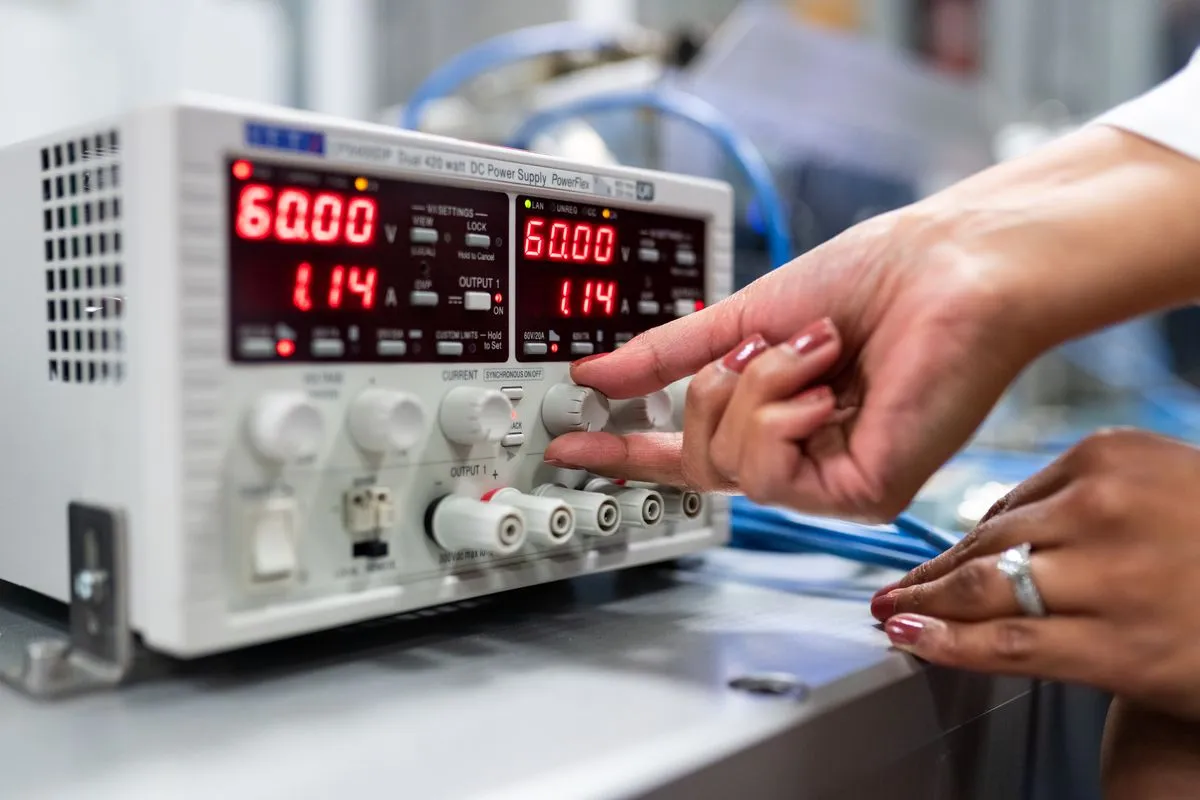
A bench power supply in diagnostics is the first line of defense protecting a board from ourselves. An unknown board with an unknown fault is dangerous: if you apply the rated voltage from the rated source, a short circuit in one circuit can destroy in seconds what could still have been saved. A bench power supply, or lab supply, gives full control over voltage and, more importantly, over current. This lets us power a board gently, locate a short by its current draw, and even heat a problem node with controlled current. Below we explain exactly how a bench supply helps find a fault without risking the board.
Safe first power-up with current limiting
The key function of a bench power supply is current limiting. We set not only the voltage but also the maximum current the source will deliver into the board. If the board is healthy, it draws its working current and starts up. If there is a short inside, the supply will not let it flare up: it hits the set limit and holds the current at a safe level.
We always power up an unknown board this way. We raise the voltage smoothly from zero and limit the current to a small value, deliberately below the level at which a defective circuit would overheat. The behavior of the source immediately reveals the state of the board. If, as the voltage rises, the current slams into the limit while the voltage does not climb, there is a short on the board, and we stop before applying full power. This careful start has saved more than one board that an ordinary power-up would have burned out in an instant.
Locating shorts by current draw
The current reading on the bench supply is itself a powerful diagnostic tool. A healthy board has a predictable consumption profile. A deviation from it reveals the nature of the fault before we even pick up a probe.
Elevated current at reduced voltage is a classic sign of a short circuit or heavy leakage. We apply a small voltage to the shorted rail with a hard current limit and use it to localize the point of the short. One working technique is to watch how the current spreads across the board: a shorted capacitor or a punctured switch heats up more than its neighbors and is easy to find. Here the bench supply works well alongside thermal imaging: the controlled current creates heat, and the thermal camera shows the point where it is dissipated. This is how a short on a multilayer board, where nothing is visible to the eye, is localized down to a specific component.
Zero or reduced consumption is also informative. It points to an open in the power circuit, a converter that is not running, or a missing load where one should be. The current profile is a kind of signature of the board, and to an experienced engineer it says a great deal.
Local heating of a problem node
The controlled current from a bench supply can be used not only to power the whole board but also to target a suspect node. By passing a limited current through a shorted or heavily drawing circuit, we make the faulty element heat up just enough to be found, but not enough to damage anything.
This technique is especially useful when hunting micro-shorts on power rails, where a whole rail is shorted and it is unclear which of the dozens of capacitors on it is at fault. We apply a small voltage to the rail with a current limit, wait for the defective component to warm up slightly, and find it with the thermal camera or by touch. Current control is essential here: without a limit the current would surge, but with one we keep the situation in hand and heat the node just to the level needed. The behavior is convenient to watch with a digital oscilloscope, so we can simultaneously see how the signal in the circuit behaves under the applied current.
Feeding power around a faulty circuit
Another valuable role of the bench power supply is substituting for the board’s own source. If the board’s own converter is faulty, we can feed the required voltage from the bench supply directly onto the secondary rail, bypassing the broken node. This lets us check whether the rest of the circuit works before repairing the converter.
This bypass start-up answers an important question: is only the power source faulty, or does the problem run deeper. If, with externally applied power, the digital part comes to life, the rails come up and the controller starts, then the defect is localized in the power circuit and the rest of the board is intact. If the node stays silent despite correct voltage, the search continues. Here the bench supply acts as a temporary prosthetic: it gives the board the correct power and lets us separate faults that would otherwise mask one another.
We use this technique carefully, checking against the schematic and documentation so that the applied voltage and polarity exactly match the circuit. Feeding the wrong voltage past the protection can do harm, so a bypass start-up always runs with current limiting and under consumption monitoring.
How the bench supply reduces the risk of killing a board
The main value of a bench power supply is that it turns the risky operation of first power-up into a controlled procedure. Industrial electronics often reach us after a failure with an unknown cause, and the rated source in that situation is a lottery. The bench supply removes the element of chance.
Current limiting keeps a short from growing into burned traces and dead neighboring components. A smooth voltage ramp lets us stop at the first sign of trouble. The consumption profile reveals the nature of the fault before anything is opened up. Bypass powering separates faults layered on top of one another. All of this means we do not finish off the board while looking for the fault, but preserve its chance of recovery. This matters most for discontinued modules, where every board is unique and a replacement can no longer be bought.
All work follows electrostatic discharge protection requirements: grounded wrist straps, antistatic mats and conductive containers. We carry out repair operations to IPC-7711 and IPC-7721 standards and assess the quality of the final joints against IPC-A-610 criteria, so that after repair the board meets the same requirements it had at manufacturing.
What we do with the bench power supply
In our process the bench power supply accompanies diagnostics from the very first power-up. With it we power a board gently with current limiting, locate a short by its draw, heat a suspect node with controlled current, and feed power around a faulty circuit to check the rest of the design. Together with analog signature analysis on BoardMaster and oscilloscope monitoring, this gives a full and, above all, safe picture of the board’s state.
We apply this approach in projects for marine electronics and oil and gas equipment, where boards work in harsh conditions and the cost of downtime is high. The full range of our diagnostic gear is described on the equipment page.
If you have a board you are afraid to power up because of an unknown fault, trust the first power-up to us. We will raise the voltage carefully, localize the failure and tell you honestly what can be restored. You can discuss the task through our contact page.