

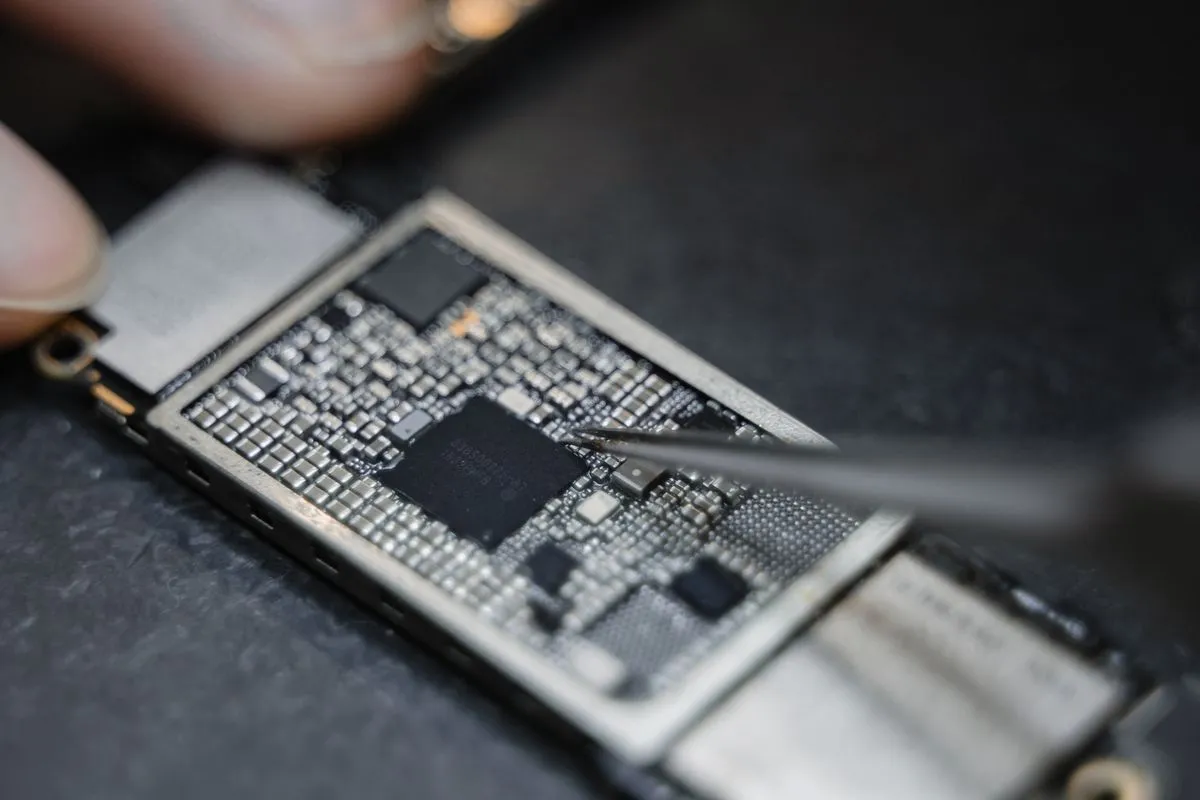
A chip programmer is the tool that lets us bring an industrial board back to life when the fault lies not in the component itself but in its contents: corrupted firmware, erased calibration or damaged settings. In component-level industrial electronics repair we do not just resolder parts, we preserve and restore the data without which a board stays dead even after flawless soldering. Below we explain which memory types we work with, how we dump and recover firmware, and why this matters for equipment that is no longer supplied.
Why repair needs a programmer
On a modern industrial board the brain of the device is almost always digital. The microcontroller holds the control program, separate memory chips keep parameters, serial numbers, calibration tables and operating logs. If that memory is damaged, the board will not start even when every power circuit is intact.
Typical situations where a programmer is essential:
- a microcontroller or memory chip has failed and needs replacement with data transfer;
- firmware got corrupted after a power surge, overheating or a write failure;
- during repair the memory contents must be saved in advance so the unique settings of a specific unit are not lost;
- the memory power circuit was faulty and data was written with errors.
In all of these cases the goal is the same: to restore the working order of the customer equipment by giving the chip back its rightful contents. This is about recovering the device own data, not about interfering with anyone else intellectual property.
Which memory types we work with
The programmer is universal across chip types, which lets us cover almost the full range of industrial boards.
EEPROM is small-capacity non-volatile memory. It usually holds parameters, trip thresholds, sensor calibrations and runtime counters. Such chips often come in serial-interface packages for I2C and SPI, and they are convenient to read even in circuit.
Flash is larger memory for the main program and data tables. This includes standalone NOR and NAND chips as well as the flash embedded inside microcontrollers. Flash corruption most often shows up as a board hanging at startup or giving no response at all.
MCU means microcontrollers with built-in program and data memory. Here we read and write the internal flash and EEPROM through programming interfaces, respecting the memory map of the specific chip family.
For each type we select the correct voltage, timings and write algorithm. An error in these parameters can damage the chip, so the work follows the chip manufacturer specification strictly.
Dumping and saving before repair
The first thing we do with any programmable board is take a firmware dump. A dump is an exact byte-for-byte copy of the memory contents. Even when a different fault is obvious, we save the data first, because soldering, component replacement or applying power all carry a risk of losing the unique contents of that specific unit.
A saved dump gives us several options at once. We get a reference we can return to if anything goes wrong. We can compare the contents against a known-good sample and see where the data diverged. And we protect the customer: even in the worst case the board calibrations and settings are not lost.
Every dump is archived and tied to the specific board and order. This is part of workbench discipline, just like ESD protection and soldering control.
Recovering corrupted firmware
When firmware is corrupted, we proceed step by step. First we read whatever remains in memory and assess the scale of the damage: whether individual cells, a whole block or the entire chip are affected. Then we compare what was read against a reference if one exists, which can be a dump from a healthy board of the same type or a previously saved copy of this same unit.
From there several paths are possible. If only a section of data is damaged, we restore the correct contents and write them back with verification afterwards. If the memory chip itself has degraded and no longer holds data, we replace the chip and transfer the restored contents onto the new component.
After writing we always run verification: the programmer compares the written contents against the source image byte by byte. A match confirms the write completed without errors. Only then does the board move on to further testing under load.
In-circuit programming and working through adapters
A chip can be read and written in two ways, and we choose the method to suit the specific board.
In-circuit programming, or ISP, lets us work with a chip right on the board without desoldering it. We connect to service pads or a technology header and access the memory through its interface. This is the gentlest approach: the component is spared unnecessary thermal stress and the risk of board damage is minimal. ISP is especially convenient for microcontrollers and serial memory that the manufacturer designed for programming while assembled.
When in-circuit access is not possible, for example when neighbouring circuits interfere with reading or the chip has to be replaced anyway, we remove the chip and work through an adapter. The programmer is fitted with a socket or converter for the specific package type, be it DIP, SOIC, TSOP, QFP or BGA. Removal and mounting are done with soldering and hot-air equipment to IPC-7711 and IPC-7721 standards, and the assembly quality is judged against IPC-A-610 criteria.
Transferring data when replacing a chip
A separate and very common task is transferring data onto a new chip when replacing memory or a microcontroller. Simply fitting a new blank chip is not enough: without firmware and settings the board stays inoperative, and without calibration tables the equipment will report wrong values.
The sequence here is as follows. We read the contents of the old chip while it is still at least partly readable, or use a previously taken dump. We remove the faulty component, install a healthy equivalent and write the saved contents into it. After writing we run verification and check the board in operation.
Such a transfer returns the device to its very own configuration: the same calibrations, the same parameters, the same serial profile. For the customer this means that after repair the unit behaves exactly as it did before the failure, with no on-site reconfiguration.
Discipline, ESD and standards
Working with programmable chips demands strict discipline. Memory chips and microcontrollers are sensitive to electrostatic discharge, so every operation follows ESD requirements: grounded wrist straps, antistatic mats, humidity control and conductive packaging for components and boards.
Soldering and desoldering are done to IPC-7711 and IPC-7721, and the finished assembly is assessed against IPC-A-610. This guarantees that after a chip replacement the board meets the same quality requirements as it did in production. This approach is part of our philosophy of repair, not waste: we return to service equipment that would otherwise be scrapped.
Firmware work is always combined with a full board diagnosis. Before touching the memory, the engineer checks the power circuits and component signatures so that correct data is not written into a knowingly faulty environment. For more on how we localize a fault, see the article on ABI BoardMaster diagnostics.
What the customer gets
For the customer, firmware recovery means the ability to repair a board that the supplier only offers to replace as a whole. This matters most for obsolete and discontinued equipment, where a new module simply cannot be sourced and the entire value of the board lies in its unique firmware and calibrations.
Memory work fits naturally into our approach of component repair instead of module swap and is used in projects for industrial drives and control processors as well as for rail transport, where equipment downtime costs more than the repair itself.
We treat the programmer as one instrument alongside the rest of the workshop equipment. Together with measurement instruments such as the LCR meter and bench multimeter, it lets us close the full cycle: from circuit diagnostics to digital content recovery.
If you have a board that will not start after a power failure or needs memory replaced while keeping its settings, bring it in for diagnosis. We will take a dump, assess the firmware condition and tell you honestly what can be recovered. You can discuss your case through our contact page.