
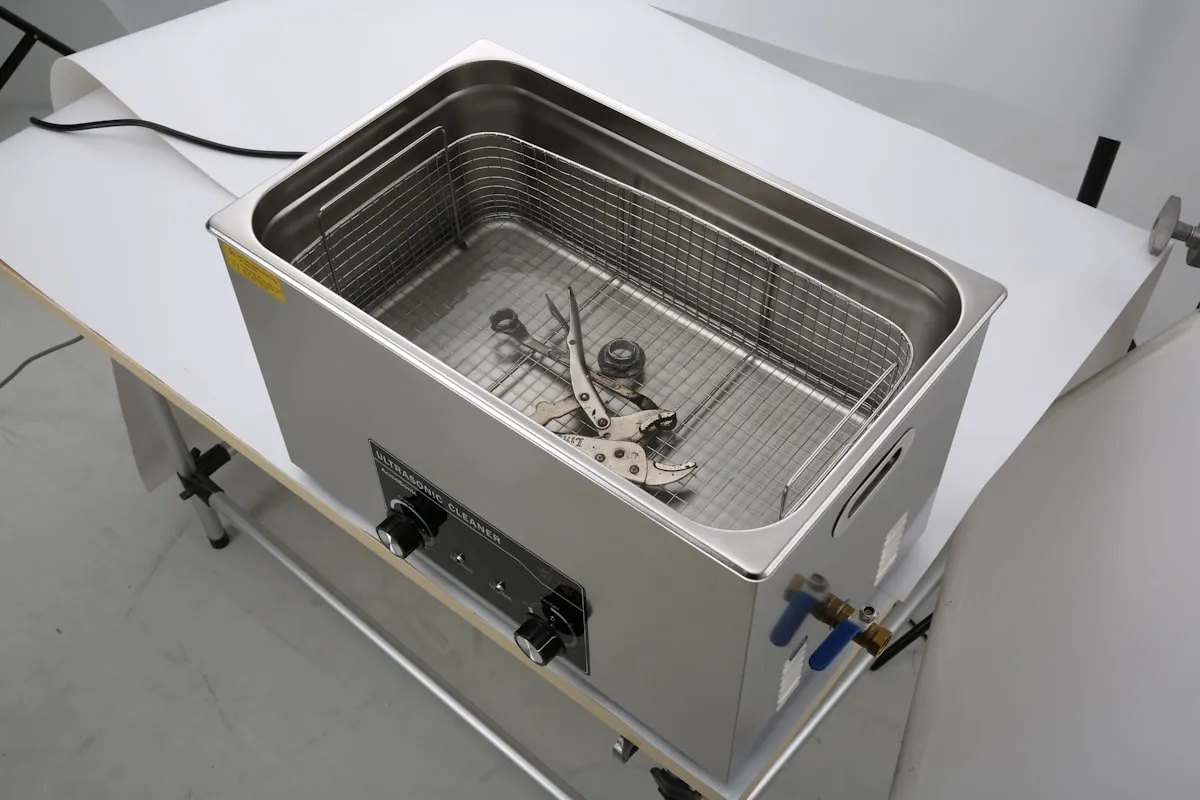
Ultrasonic cleaning of circuit boards is one of the core processes in our workshop, without which neither precise repair nor reliable conformal coating is possible. A contaminated board hides defects, produces leakage currents and prevents quality soldering. In the ultrasonic tank we remove flux residue, dust, corrosion products and condensation traces, returning the board to a clean, workable state. Below we explain in detail what exactly we do during ultrasonic cleaning, how we choose the settings, and what precautions we observe.
How ultrasonic cleaning works
In an ultrasonic tank a board immersed in solution is treated with high-frequency acoustic vibrations. Cavitation occurs in the liquid: microscopic bubbles form and collapse, mechanically dislodging contamination even from the most inaccessible places, from under component bodies, from connector gaps, from the clearance beneath planar chips. Neither a brush nor a jet of solvent can reach there, whereas cavitation acts across the entire wetted surface at once.
This is exactly why ultrasound is indispensable for dense modern assembly. Under a QFN or BGA package there is always a gap where flux collects, and washing it out by hand is impossible. The ultrasonic tank solves this task without dismantling the node.
What we clean off the board
Contamination on a board comes in many forms, and each type calls for its own approach:
- Flux residue after soldering. Active flux that has not been fully removed produces leakage currents and electrochemical migration over time, up to surface shorts.
- Dust and production contamination. Conductive dust combined with moisture reduces insulation resistance and causes faults.
- Corrosion products. A greenish or white deposit around leads is the result of moisture and the aggressive environment typical of equipment from vessels and oil and gas facilities.
- Condensation and electrolyte traces. After flooding, dew formation or a leaked capacitor, salts remain on the board that must be removed completely.
Before cleaning we always assess the nature of the contamination under magnification, because it determines the choice of solution and cycle.
Choosing the solutions
There is no universal solution, and selecting the cleaning medium is a responsible part of the process. We base it on the type of contamination and compatibility with the components:
- Specialised aqueous board-cleaning agents are the main choice for flux residue and general cleaning. They are designed specifically for electronics and are not aggressive to markings and components.
- Isopropyl alcohol is used for light flux residue and where water is undesirable.
- For stubborn corrosion products we use agents intended to remove oxides, with mandatory subsequent neutralisation and a rinse in deionised water.
A final rinse in deionised water is fundamentally important: ordinary tap water leaves a salt deposit that itself becomes a source of leakage currents. We finish the cycle precisely with a clean rinse, so that neither contamination nor traces of the cleaning agent remain on the board.
Temperature and cycle time
Cleaning effectiveness depends on three parameters: solution concentration, temperature and time. Moderate heating of the tank speeds up flux dissolution and improves cavitation efficiency, but overheating is not acceptable: it is harmful to components and can damage markings. We keep the temperature within the range recommended for the specific agent and do not chase speed at the board’s expense.
We select the cycle time according to the contamination: light flux residue clears in a few minutes, stubborn corrosion requires longer treatment, sometimes in several passes with intermediate checks. The principle of reasonable sufficiency matters: excessively long treatment with powerful ultrasound is not a benefit but a risk for sensitive parts. We therefore run the process under control, rather than on a set-and-forget basis.
Drying after cleaning
Cleaning does not end when the board is lifted out of the tank. Moisture remaining in the gaps is just as dangerous as the original contamination: under bodies and in connectors, water produces corrosion and leakage currents. Drying is therefore a mandatory and full-fledged stage.
We remove the bulk of the moisture with clean compressed air, paying attention to the zones under components and inside connectors, and then finish drying the board in a thermal cabinet at a moderate temperature until the residual moisture is completely gone. Only a fully dry board is allowed to proceed to further repair or coating. We check the quality of drying visually under the microscope, the use of which we covered in our article on the microscope for soldering.
When cleaning is needed before repair and coating
Ultrasonic cleaning is built into our process at two key points.
Before repair, cleaning is needed when a board arrives dirty, flooded or corroded. A clean surface is essential for accurate diagnostics: under a layer of flux and deposit you can see neither cracks in joints nor damaged traces. A cleaned board makes it possible to reliably localise the fault, including by comparison with a known-good reference, which we described in our article on fault localisation with BoardMaster.
Before applying conformal coating, cleaning is always required. Coating goes on only over a clean and dry surface. If flux residue or moisture gets under the coating, it will be sealed onto the board forever and will keep destroying it from within, while the coating itself will peel. Quality conformal coating therefore starts precisely with thorough ultrasonic cleaning and complete drying.
Precautions
Ultrasound is a powerful tool, and a number of components require a careful approach to it. Not everything on a board tolerates cavitation and immersion equally well.
What requires special attention:
- Electromechanical relays and reed switches. Cavitation can damage the contact group or drive liquid inside the housing. Such components are either protected or excluded from the treatment zone.
- Connectors and trimmer elements. Liquid easily gets inside and is then hard to dry out completely. We give such nodes special attention during blow-off and drying.
- Stickers, labels and markings. Ultrasound and solvent can peel or wash them off. We record important designations in advance.
- Open electrolytic capacitors and non-sealed modules. These require assessment before immersion.
All work is done in accordance with ESD requirements, and we adapt the process to the specific board rather than running everything to a single template. If some node cannot be immersed, we clean the board locally, protecting the vulnerable components.
What we do during ultrasonic cleaning
To bring it together, during ultrasonic cleaning we: remove flux residue, dust, corrosion products and condensation traces, select the solution and cycle for the specific contamination, finish the cycle with a deionised-water rinse, fully dry the board and check the result under the microscope. This is a mandatory stage both before precise repair and before applying conformal coating, and part of the overall culture of working with industrial electronics.
A clean board is not cosmetics but a condition for reliable repair. On a contaminated surface you can neither see a defect nor guarantee the durability of the result.
If you have a board that has been flooded, corroded or affected by a leaked capacitor, bring it to us. We will assess its condition, run ultrasonic cleaning in the appropriate cycle and prepare the board for repair or coating. You can discuss your task through our contact page.